Overview
In Fall 2017, I began working on Paradigm Hyperloop, an international team of students from Northeastern University and Memorial University of Newfoundland & Labrador.
The team previously achieved second place in Elon Musk’s Hyperloop Pod Competition II and was the only North American finalist. We were developing a new pod for the next competition.
My initial responsibilities included redesigning the pod’s suspension system with focus on design for manufacturing (DFM) and simplified assembly.
Design
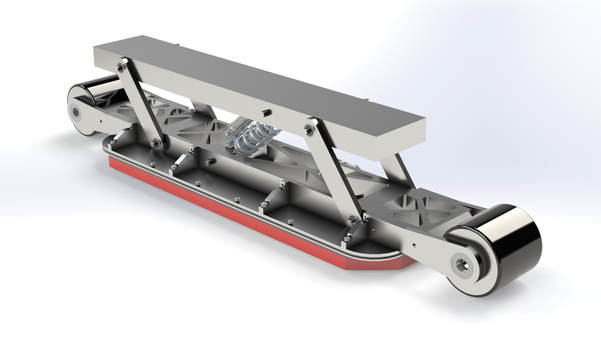
The Paradigm Hyperloop Pod relies on air skate levitation. Air is forced through the red nylon airbags, drastically reducing friction between the pod and the track. When no air is supplied, the pod rests on its wheels.
Air bearings are the core technology we have developed for Competition II. While air bearings are already utilized in low speed industrial applications, they’ve never been explored in high-speed contexts. Low-friction levitation is critical to the Hyperloop concept and our air bearings reduce the force necessary to propel our pod by 80%.
The pod uses four air skate assemblies, each equipped with independent suspension featuring a parallel four-bar linkage with centralized damped spring.
 Improved Suspension