Documentation of the main branch
These pages follow Mallard's main branch, which is ahead of release 0.8.0: some features they describe come with the next release.
Boundary conditions
Every boundary face gets its condition from a [[boundaries]] entry naming its
zone (see Meshes for where zones come from). Conditions are
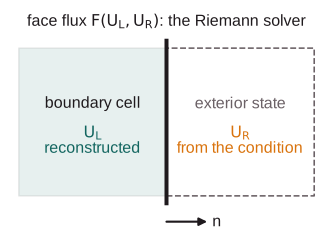
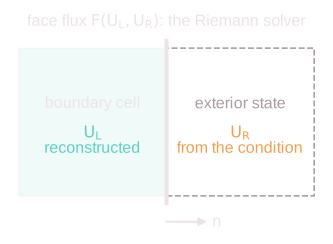
imposed weakly: each one supplies an exterior state, and the Riemann solver
computes the face flux from it and the reconstructed interior state.
[[boundaries]]
name = "left"           # the zone
type = "upt"            # the condition
u = [1.0, 0.0]
p = 1.0
T = 1.0

[[boundaries]]
name = "right"
type = "p_out"
p = 1.0
Rules:
- Each boundary face must be assigned exactly once. A zone the mesh does not have is an error that lists the mesh's zones, and so are a face assigned twice and an entry that selects no faces.
- Periodic zones are interior faces and take no entry; a fully periodic mesh
needs no
[[boundaries]]. where = "<expression in x, y, z>"splits a zone between entries: each takes the faces whose centers satisfy its expression.
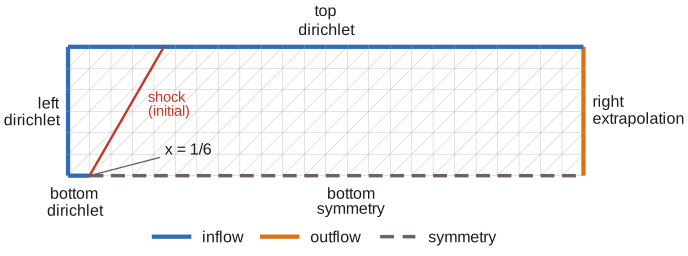
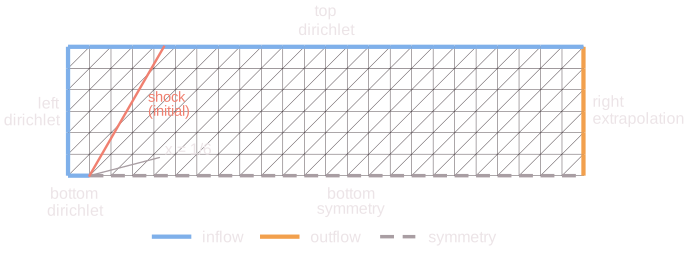
examples/double_mach: the bottom zone is post-shock inflow for x < 1/6
and a reflecting wall beyond (where), and top follows the exact moving
shock (dirichlet with expressions of t).
[[boundaries]]
name = "bottom"
type = "dirichlet"
where = "x < 1/6"
rho = "8.0"
u = ["7.1447096811216", "-4.125"]
p = "116.5"

[[boundaries]]
name = "bottom"
type = "symmetry"
where = "x >= 1/6"
Choosing a condition
type |
Kind | Keys | Use |
|---|---|---|---|
wall_adiabatic |
wall | u (optional) |
No-slip (navier_stokes) or slip (euler) wall without heat flux; u moves the wall |
wall_isothermal |
wall | T, u (optional) |
Wall at temperature T |
wall_heat_flux |
wall | q, u (optional) |
Wall with heat flux q into the fluid |
symmetry |
symmetry | — | Slip wall, symmetry plane, axis of axisymmetric runs |
upt |
inflow | u, p, T (+ X/Y) |
Inflow at a given velocity, pressure and temperature |
farfield |
far field | u, p, T |
Free stream around a body: characteristic, works for inflow, outflow and tangential flow |
dirichlet |
inflow | rho, u, p (expressions of x, y, z, t) |
Prescribed exterior state, e.g. an exact solution |
extrapolation |
outflow | — | Transmissive: the state from inside; supersonic outflow, or waves leaving a box |
p_out |
outflow | p |
Subsonic outlet at pressure p (reflects acoustic waves) |
p_out_average |
outflow | p |
Outlet with mixed subsonic and supersonic faces: the area-averaged pressure is p, the profile free |
nscbc_outlet |
outflow | p, L, sigma, beta |
Partially non-reflecting characteristic outlet (below) |
nscbc_inlet |
inflow | u, p, T, L, sigma, ... |
Partially non-reflecting characteristic inlet, optionally with synthetic turbulence |
Gas mixtures add the composition (X or Y, and balance) to upt and
nscbc_inlet, as numbers or expressions of x, y, z. Their walls are
non-catalytic (no species crosses them), and all three wall_* types work,
e.g. a cold wall that quenches a flame:
Pitfall: the wall heat flux is conducted across the half cell next to the wall, so it is only as good as the resolution there; a flame quenching against a wall needs cells of a fraction of its quenching distance.
Choosing:
- External aerodynamics:
farfieldon the outer boundary, awall_*on the body (examples/cylinder,sphere_re300). - Ducts and combustors:
nscbc_inletandnscbc_outletkeep acoustic waves from reflecting into the domain (flame_outflow,volvo_bluff_body);uptandp_outare simpler but reflect them (97–99% of a pulse atp_out, about 1% atnscbc_outlet). - Supersonic outflow:
extrapolation, orp_out_averageif part of the outlet is subsonic. - Exact or manufactured solutions, moving shocks:
dirichlet.
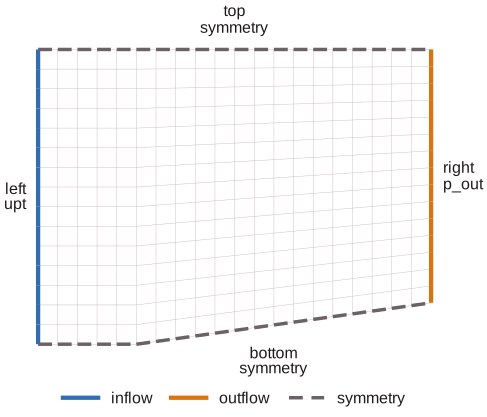
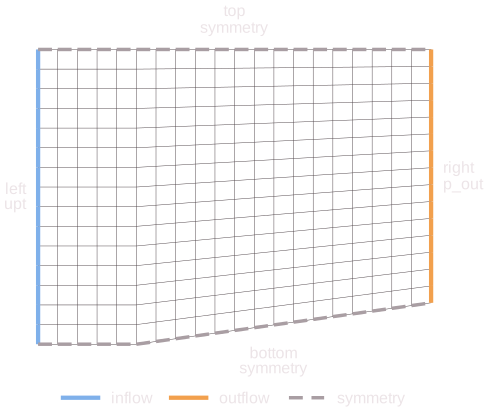
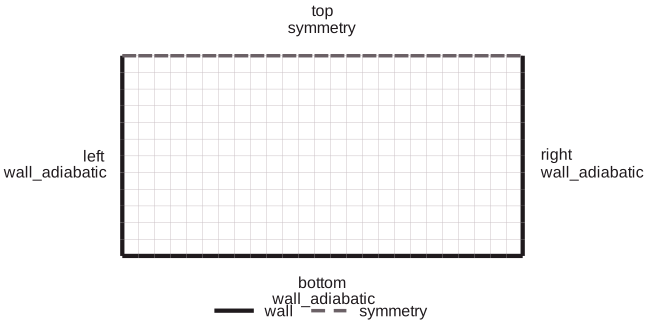
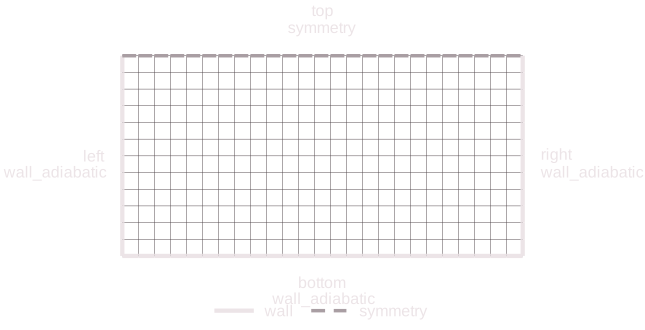
examples/wedge (Mach 1.76 over an 8° ramp) and
examples/viscous_shock_tube (shock / boundary-layer interaction in a closed
box), drawn on their generated meshes.
Characteristic boundaries
nscbc_outlet and nscbc_inlet let outgoing waves leave and relax the
incoming ones toward a target (Poinsot & Lele 1992, with the transverse terms
of Lodato et al. 2008):
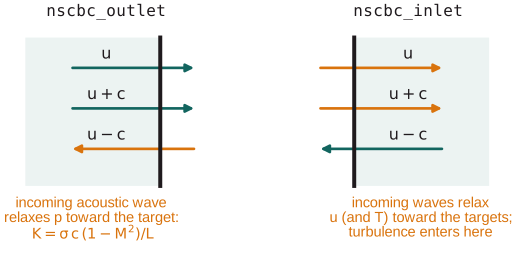
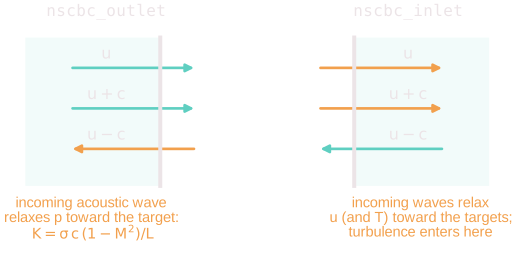
u carries entropy, vorticity and species; u ± c are the acoustic waves.
[[boundaries]]
name = "outlet"
type = "nscbc_outlet"
p = 101325.0
L = 0.1            # a length of the domain [m]
# sigma = 0.25     # relaxation: 0 is perfectly non-reflecting but drifts
| Key | Default | Meaning |
|---|---|---|
p |
required | Target (outlet) or reference (inlet) pressure |
L |
required | A length of the domain, setting the relaxation rate K = sigma c (1 - M^2) / L |
sigma |
0.25 | Relaxation coefficient; 0 lets the mean drift, large values approach a fixed pressure |
beta |
local Mach (outlet); 0 for a turbulent inlet | Weight of the transverse terms, 0 to 1 |
u, T |
required (inlet) | Target velocity (numbers or expressions of x, y, z) and temperature |
sigma_T, sigma_t |
imposed | Inlet: relax temperature and tangential velocity instead of imposing them |
A wave of frequency omega is reflected by 1 / sqrt(1 + (2 omega / K)^2).
Restart files carry each face's state, so restarted runs continue bitwise.
Synthetic turbulence
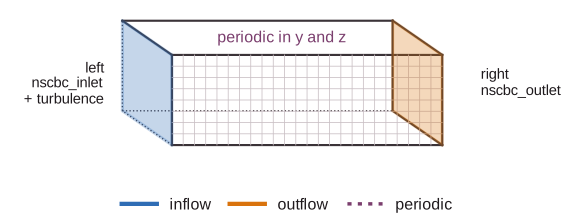
An nscbc_inlet with a [boundaries.turbulence] table adds turbulence to its
target velocity: the digital filter of Klein, Sadiki & Janicka (2003), with
given Reynolds stresses and integral length scales, bitwise the same on any
number of ranks and across restarts.
[[boundaries]]
name = "left"
type = "nscbc_inlet"
u = [1.0, 0.0, 0.0]
p = 17.857
T = 1.0
L = 6.0

[boundaries.turbulence]
reynolds_stress = [0.01, 0.01, 0.01, 0.0, 0.0, 0.0]   # R_xx, R_yy, R_zz, R_xy, R_xz, R_yz
length_scale = 0.25
| Key | Default | Meaning |
|---|---|---|
reynolds_stress |
required (or profile) |
[R_xx, R_yy, R_zz, R_xy, R_xz, R_yz] (2D: [R_xx, R_yy, R_xy]), numbers or expressions |
profile |
— | Instead of u and reynolds_stress: a CSV of plane averages from a precursor run (tools/plane_average.py) |
length_scale |
required | Integral length: one number, one per direction, or one list per component |
convection_velocity |
mean inflow speed | U_c of Taylor's hypothesis |
seed |
1 | Random seed |
zero_net_flux |
true |
Remove the area mean of the normal fluctuation (no plane acoustic wave) |
points_per_length |
6 | Generator grid points per smallest integral length |
The inlet must be planar and normal to a coordinate axis. Examples:
turbulent_inflow_duct, channel_inflow_retau180 (statistics from the
periodic channel via profile), volvo_bluff_body
(validation).
Pitfalls
- Reflections.
p_outanduptreflect acoustic waves; in long runs of low-Mach flows these can dominate. Use the characteristic conditions, and a sponge layer in front of the outlet where eddies leave. - Reversed flow at outlets. Eddies leaving through an
nscbc_outletmay reverse the flow in its last cells; such faces drop their transverse terms, andbeta = 0is more robust (thechannel_inflow_retau180example). - Viscous terms treat characteristic and transmissive faces like
extrapolation(zero normal gradients).