Documentation of the main branch
These pages follow Mallard's main branch, which is ahead of release 0.8.0: some features they describe come with the next release.
Sources and sponges
Source terms add to the right-hand side per unit volume: gravity, body forces that hold a mass flow, arbitrary expressions, and sponge layers that damp the solution toward a reference state.
[source]
| Key | Default | Meaning |
|---|---|---|
gravity |
none | Gravitational acceleration vector |
mass_flow |
none | Hold the volume average of rho u at this vector with a uniform body force (periodic channels and pipes) |
rho, rhou, rhoE |
"0" |
Mass, momentum (one expression per component) and energy sources, expressions of x, y, z, t |
time_dependent |
false |
Re-evaluate the expressions at every Runge–Kutta stage (on the host: costly on large meshes); otherwise once at the start |
Constant mass flow
A periodic channel has no inlet to fix its flow rate. mass_flow adds the
uniform body force that keeps the volume-averaged momentum at the given value,
correcting every stage so that a flow started at the target stays there to
rounding; the energy gains the force's work.
# examples/channel_retau180: bulk density and velocity 1 along x
[source]
mass_flow = [1.0, 0.0, 0.0]
Gravity
Pitfall: the scheme is not exactly well balanced. A hydrostatic atmosphere
carries spurious velocities of about 1e-4 of the sound speed on a 32 x 32
mesh, which vanish at second order under refinement; wall and symmetry ghost
states continue the hydrostatic pressure gradient. The poiseuille_pipe
example drives a pipe flow with gravity as a body force.
Sponge layers
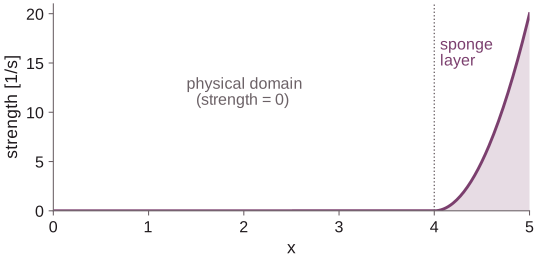
[[sponges]] add -strength (U - U_ref) to the conservative variables (and
species), damping the solution toward a reference state where the strength is
nonzero. They absorb eddies and waves before an outlet, where characteristic
conditions alone may reflect them or let reversed flow in.
[[sponges]]
strength = "x > 4 ? 20 * ((x - 4) / 1)^2 : 0"   # 1/s; a gradual ramp reflects less than a step
u = [1.0, 0.0]
p = 1.0
T = 1.0
| Key | Default | Meaning |
|---|---|---|
strength |
required | Damping rate [1/s], a number or an expression of x, y, z; zero outside the layer |
u, p, T |
required | Reference state, numbers or expressions of x, y, z |
X or Y, balance |
— | Mixtures: reference composition |
Several sponges add up. Strength and reference are evaluated once, at cell
centroids. The source is explicit and caps the time step at
1 / max(strength). Example: channel_inflow_retau180, a sponge over the last
fifth of the channel in front of its nscbc_outlet.