Documentation of the main branch
These pages follow Mallard's main branch, which is ahead of release 0.8.0: some features they describe come with the next release.
Numerics
Mallard is an explicit, cell-centered finite volume method: each face flux is an approximate Riemann solver applied to states reconstructed on both sides, and Runge–Kutta schemes advance the cell averages. This page is about choosing the options; Numerical methods has the formulation.
Presets
A preset picks a validated combination of every scheme choice on this page, so most inputs need one line:
| Preset | Reconstruction | Flux | Time integrator | cfl |
For |
|---|---|---|---|---|---|
robust |
MUSCL, Venkatakrishnan limiter | RHLL | SSPRK3 | 0.5 | First runs, complex geometry, strong shocks and blasts |
accurate |
TENO-E, order 5 | HLLC | SSPRK3 | 1.0 | Smooth flow, acoustics, vortices, moderate shocks |
les |
MUSCL, no limiter | hybrid (KEEP central, HLLC at shocks) | SSPRK3 | 0.8 | Turbulence: LES and DNS |
reacting |
MUSCL, Venkatakrishnan limiter | HLLC | SSPRK3 | 0.35 | Flames and detonations with [chemistry] |
Why each, and what it passes (each check runs in the test suite,
PresetValidation.*, with the preset alone):
robustnever needs a stencil setup, works on every cell type and physics, and has the fewest ways to fail. RHLL does not grow carbuncles at strong shocks on blunt bodies or grid-aligned faces.cfl = 0.5is the first-order positivity bound of the explicit update in Mallard's CFL convention: the Noh implosion (examples/noh_axisymmetric, an infinite-strength shock into gas atp = 1e-6) keeps a positive pressure at 0.5 on 40², 60² and 200² cells, but not at 0.8 on 200² (accurategoes to negative pressure on it); on 60² the plateau density is within 7% of 64. On Sod's problem the L1 density error is 0.0029 at 200 cells.accurateis fifth order where the flow is smooth (4.9 measured on a convected density wave on triangles, 16² to 32² cells, at its owncfl) and ENO at discontinuities: the examplessod,riemann_2d,explosion_3d,taylor_green_3dandisotropic_turbulenceuse exactly these keys (validation). It costs a stencil setup (seconds per million cells on a GPU, minutes on CPUs) and memory, and is not bound preserving: addbound_preserving = trueand a smallercflfor blasts.lesleaves the dissipation to the viscosity and the SGS model: on a viscous 2D Taylor–Green vortex at Mach 0.1 (16² cells) the kinetic energy decays at the exact viscous rate to 0.02%, against 8% too fast withrobust. TENO with the central flux feeds energy into the resolved field, hence the unlimited MUSCL states (LES design). These are the keys ofcbc_lesandchannel_les, within 0.7–1.6% of the DNS (validation).reacting: the scheme of the validated flames and detonations (validation).cfl = 0.35keeps the Strang splitting error of a CJ detonation's induction length within 5% (25% at 1.0). A stoichiometric H2/air flame at 700 K, 6 cells per thermal thickness, propagates within 0.7% of Cantera's speed. Steady flames alone are insensitive tocfl(0.05% from 0.2 to 2.0): setcfl = 1.0to run them three times faster, or use[chemistry] coupling = "simpler".
Any key the input sets wins over the preset, so a preset is also a starting point:
[numerics]
preset = "accurate"
riemann_solver = "RHLL"     # grid-aligned strong shocks

[numerics.face_reconstruction]
order = 3                   # TENO-E 3 instead of 5
Reconstruction options (order, limiter) apply only when the
reconstruction type is the preset's: type = "MUSCL" under accurate gets
MUSCL's own defaults, not order = 5. The preset's cfl applies only when
[run] sets neither cfl nor dt. Without a preset the defaults below
apply, unchanged (first order). The log names the preset and every key the
input overrides, and the Numerics section of the log lists what is used:
== Numerics ===========================
  Preset             accurate (the input sets numerics.riemann_solver = RHLL)
  Reconstruction     TENO, order 5 (degree 4), 3 face quadrature points
  Riemann solver     RHLL
Each example's closest preset runs in the test suite
(Examples/ExampleUnderPreset.*).
Time step and stopping
[run]
cfl = 1.0          # or dt = 1.0e-4 (exactly one of the two)
t_stop = 0.2       # and/or n_steps, t_wall_stop
| Key | Default | Meaning |
|---|---|---|
cfl |
— | CFL number: the time step adapts to it every step |
dt |
— | Fixed time step |
t_stop |
none | Stop at this time; the last step is shortened to land on it |
n_steps |
none | Stop after this many steps |
t_wall_stop |
none | Stop after this many seconds of wall time |
cuda_graphs |
true |
CUDA builds: launch each step as one CUDA graph where possible (same results) |
With a numerics preset cfl may be left out: the preset sets it.
At least one stop condition is required; the first one reached ends the run.
cfl is the usual unstructured CFL number: on a uniform 2D grid of spacing h,
dt = cfl * h / (|u| + |v| + 2a) (viscous, diffusive and source limits
included). Boundary faces count the wave speed of their exterior state too
(the inflow state of upt, dirichlet and inlets, the target of
nscbc_inlet), so a fast jet entering a domain at rest runs from the first
step at the requested cfl.
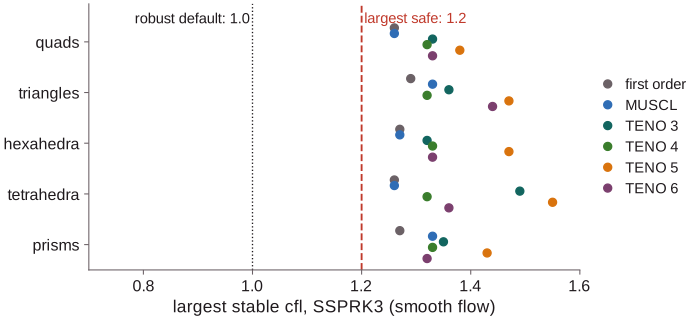
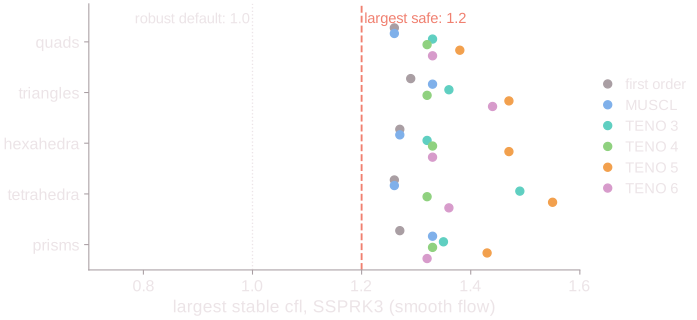
Largest stable cfl for smooth flow with SSPRK3 (RK4 allows about 10%
more), measured on periodic boxes (tables).
Rules of thumb:
cfl = 1.0with SSPRK3 is a robust default, shocks included; at most 1.2 (SSPRK3) or 1.35 (RK4) for any cell type.- Extreme shocks with bound-preserving TENO need less: 0.25 for the Noh implosion.
- Chemistry can bind first: detonations with Strang splitting need about
0.35, or
coupling = "simpler"at 1.0 (Thermochemistry). - Inputs from Mallard 0.5 and earlier give the same time step with half their
cfl.
Reconstruction
[numerics.face_reconstruction]
type = "TENO"      # "FO", "MUSCL" or "TENO"; the default is "FO"
order = 5          # TENO: 3 to 6
The default is first order
Without a preset or [numerics.face_reconstruction] Mallard
runs first order. Every example sets a preset or the reconstruction.
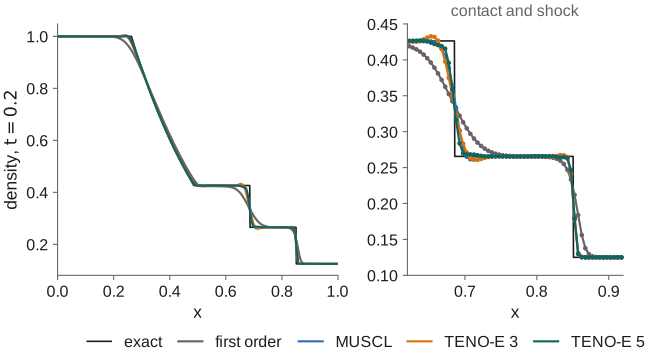
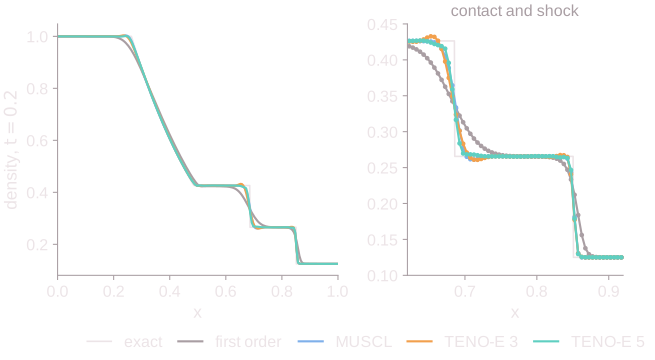
The Sod example (200 cells) with each reconstruction, read through a line probe. With TENO-E 5 the contact spreads over about five cells and the shock over two.
type |
Order | Use |
|---|---|---|
FO |
1 | Debugging and start-up transients; the most robust and dissipative |
MUSCL |
2 | Robust and cheap; complex geometry, very large meshes, DNS of wall turbulence at fine resolution |
TENO |
3–6 | TENO-E (Liang, Shyy & Fu 2025): high order in smooth regions, essentially non-oscillatory at shocks. Order 5 is the usual choice |
MUSCL keys: limiter (venkatakrishnan, the default; barth_jespersen;
none) and venkatakrishnan_K (default 5; larger is less limiting).
TENO-E reconstructs each cell from a large central stencil where the flow is smooth, and switches per characteristic variable to the smoothest of its sector stencils where a troubled-cell indicator detects a discontinuity:
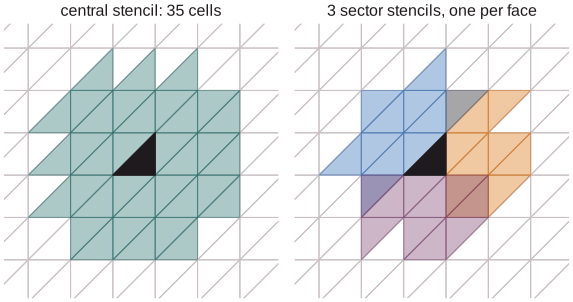
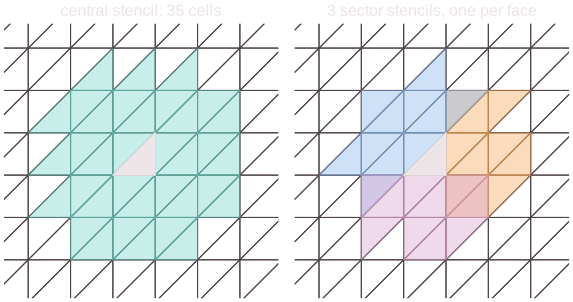
Stencils of one triangle (black) for fifth-order TENO-E, read back from Mallard's stencil cache.
TENO-E options
| Key | Default | Meaning |
|---|---|---|
order |
5 | 3 to 6 |
bound_preserving |
false |
Keep density and pressure in the neighbors' range in troubled cells: for very strong shocks and blasts (Noh, Sedov, Mach 8 flows) |
stencil_factor |
2 | Large-stencil size over the number of coefficients; 1.5 is markedly less dissipative for fine smooth waves, less robust at shocks |
troubled_threshold, troubled_upper |
1e-3, 1e-2 | Troubled-cell indicator: where stencil selection starts, and where its cutoff is most dissipative |
C_T |
adaptive | Fixed TENO cutoff instead of the adaptive one (1e-10 to 1e-6) |
characteristic |
true |
Select stencils on characteristic variables |
small_stencil_size |
10 (2D), 18 (3D) | Cells per sector stencil |
max_condition |
1e8 | Conditioning bound of the least-squares systems |
cache_file |
none | Save the stencils and matrices, and reuse them on later runs of the same mesh and options |
cache_single_precision |
false |
Store the cache in single precision (half the size) |
single_precision_tables |
false |
3D, single gas: keep the matrices in single precision on the device: ~40% less memory, 3–8% faster, results change at round-off |
troubled_capacity |
0.5 (3D), 1 (2D) | Share of cells the troubled-cell passes handle at a time (memory) |
curved_mirrors, curved_wall_degree |
false, 3 |
Stencils at curved walls |
Pitfalls:
- Setup time. TENO-E precomputes its stencils at the start: seconds per
million cells on a GPU (3D), minutes on CPUs. Set
cache_filefor repeated runs of the same mesh; the cache is checked against the mesh and options and recomputed if they differ. Its size is several KB per cell (tens in 3D). - Memory. 3D TENO5 needs about 40 KB per hexahedron on the device (an
A100-80GB holds about 2.1M);
single_precision_tablesstretches that to about 3.4M. - The troubled-cell share is in every progress row; output
TENO_SIGMAto see where stencils are being selected.
Riemann solvers
riemann_solver |
Use |
|---|---|
HLLC |
Default: resolves contacts and shear layers; all-round choice |
HLL |
More dissipative at contacts and shear layers; with bound-preserving TENO for the Mach 3 sphere on tetrahedra |
Roe |
Low dissipation, with Harten's entropy fix |
Rusanov |
The most dissipative |
RHLL |
Rotated hybrid HLL-Roe: no carbuncle at strong shocks on blunt bodies and grid-aligned shocks (the double Mach reflection, Mach 8 flows, blunt-body detonations) |
All five work for gas mixtures. On a 1D problem with fifth-order TENO the
choice matters little (within 20% on Sod); in 2D it decides whether strong
shocks grow carbuncles: use RHLL there
(stationary shocks).
Time integration and other options
[numerics] key |
Default | Meaning |
|---|---|---|
time_integrator |
"SSPRK3" |
FE (forward Euler), SSPRK3 or RK4 |
low_mach_cutoff |
0.1 | Low-Mach correction: the upwind dissipation scales with the flow speed down to this Mach number; 1 disables it |
convective_flux |
"riemann" |
hybrid: central kinetic-energy-preserving flux with the Riemann solver at shocks (LES) |
double_flux |
false |
Gas mixtures: no pressure oscillations at contacts between different gases (Thermochemistry) |
check_nan |
false |
Stop as soon as the solution is not finite |
The low-Mach correction matters below about Mach 0.3: without it, upwind dissipation at M = 0.1 removes a third of the resolved enstrophy of an under-resolved Taylor–Green vortex. Leave it on except for comparisons.