Documentation of the main branch
These pages follow Mallard's main branch, which is ahead of release 0.8.0: some features they describe come with the next release.
Initialization and restarts
[initialize] sets the state at the start of a run: uniform, from
expressions, or from a restart file written by an earlier run or by a script.
Uniform state
[initialize]
type = "constant"     # the default
u = [0.2, 0.0]
p = 0.7142857142857143
T = 1.0
# X = { O2 = 1.0, N2 = 3.76 }   gas mixtures: the composition
Expressions
# examples/riemann_2d: the four quadrants of configuration 3
[initialize]
type = "analytical"
rho = """\
    x >= 0.8 ? (y >= 0.8 ? 1.5 : 0.532258064516129) \
             : (y >= 0.8 ? 0.532258064516129 : 0.137992831541219)"""
u = ["x >= 0.8 ? 0.0 : 1.206045378311055",
     "y >= 0.8 ? 0.0 : 1.206045378311055"]
p = """\
    x >= 0.8 ? (y >= 0.8 ? 1.5 : 0.3) \
             : (y >= 0.8 ? 0.3 : 0.029032258064516)"""
| Key | Default | Meaning |
|---|---|---|
type |
"constant" |
constant, analytical, restart, or remap (a restart file of another mesh) |
u |
required | constant: numbers; analytical: one expression per component |
p, T (constant) |
required | Pressure and temperature |
rho, p, T (analytical) |
two of the three | Expressions of x, y, z |
X or Y |
required for mixtures | Composition by species: numbers, or expressions (analytical) |
balance |
none | Mixtures, analytical: the species that takes 1 - sum of the others |
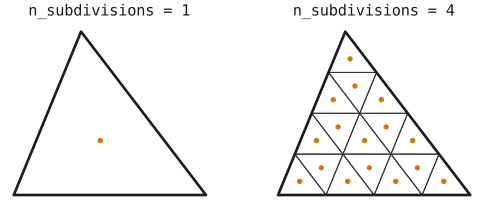
n_subdivisions |
4 (2D), 1 (3D) | Resolution of the cell averages of analytical states |
file |
required (restart) |
Restart file to start from |
Analytical states are integrated over each cell, not sampled at its center,
so discontinuities that cut a cell give the right average (and high-order runs
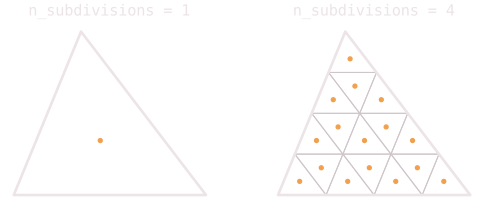
start from true cell averages). In 2D each cell's triangles are split into
n_subdivisions² sub-triangles; in 3D each tetrahedron of a cell into
n_subdivisions³ sub-tetrahedra with a degree-5 rule. Raise it for sharp
features smaller than a cell.
Expressions use exprtk syntax
(see Input files). Pitfall:
TOML requires the expressions to be strings, also for constants: u =
["0.0", "0.0"] with analytical.
Restarts
[initialize]
type = "restart"
file = "solut/restart_010000.restart"

[[write_data]]                 # and keep writing them
prefix = "solut/restart"
format = "restart"
interval = 10000
format = "restart" in [[write_data]] writes the conservative variables
(and whatever else the run needs to continue: chemistry sub-steps, the soot
foil P_MAX, [statistics] averages, characteristic boundary states) in
global cell order. A restarted run continues the uninterrupted one bit for
bit, also on a different number of MPI ranks, or serially from a parallel
run. The step and time continue from the file; t_stop and n_steps refer to
the total.
[statistics] reset = truestarts the averages afresh instead of continuing them.- Probes and force monitors append to their files on a restart.
- Restart files of Mallard 0.3 and earlier (version 1) are still read.
compression = "zlib"writes compressed restart files (version 5, losslessly: they restart bit for bit), about a third smaller for smooth flows; reading them needs a build withMallard_ENABLE_ZLIB, and the Python tools intools/read only uncompressed ones.
Initial states from scripts
Many examples start from a restart file that a script in tools/ computes:
a Cantera flame, a ZND detonation, a turbulent field. These are the patterns
to copy for your own cases:
| Script | Initial state |
|---|---|
flame_restart.py |
Premixed flame in its own frame from a Cantera solution (1D, or a wrinkled 2D front) |
znd_restart.py |
ZND detonation profile, with pockets of fresh gas to trigger cells |
channel_init.py |
Turbulent channel: mean profile plus a divergence-free perturbation |
isotropic_turbulence_restart.py |
Isotropic turbulence with a given spectrum |
autoignition_restart.py |
Stratified temperature and velocity fields |
interpolate_restart.py |
A restart file interpolated onto another Gmsh mesh (nearest cells; type = "remap" below is conservative and high order) |
tile_restart.py |
A restart file of a periodic box tiled into a larger box |
A restart file is binary, little-endian: the 16 bytes MALLARD-RESTART\0,
then uint32 version (2) and real size (8), uint64 cell count, variable
count and step, float64 time, each variable name as a uint32 length and its
characters, and finally the values, variable after variable, each over all
cells in the mesh's global order. The variables are RHO, RHOU_X, RHOU_Y
(RHOU_Z), RHOE and, for gas mixtures, RHOY_<species> for every species
and T_SEED (a temperature guess); channel_init.py has a short writer.
Remap from another mesh
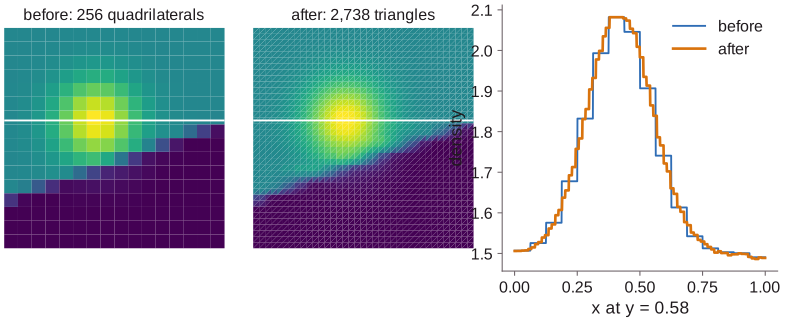
type = "remap" starts from a restart file written on a different mesh: a
finer one (grid convergence, spinning up an LES from a coarse run), another
cell type, any partition and rank count on either side. Give the source run's
mesh as [initialize.mesh]:
# examples/riemann_2d_quads/remap.toml: 10,000 quads at t = 0.5 onto 131,072 triangles
[initialize]
type = "remap"
file = "coarse/riemann_000218.restart"
degree = 3              # of the source polynomials, 0-5 (default 2)
# limiter = "none"      # for smooth fields; default "bounds"

[initialize.mesh]       # the source run's [mesh] table
type = "cartesian"
Nx = 100
Ny = 100
| Key | Default | Meaning |
|---|---|---|
file |
required | Restart file of the source run |
[initialize.mesh] |
required | The source run's [mesh] table |
[[initialize.periodic]] |
the run's [[periodic]] |
The source mesh's periodic zone pairs |
degree |
2 | Degree of each source cell's least-squares polynomial |
limiter |
"bounds" |
bounds: no new extrema, no negative partial densities; none: full order |
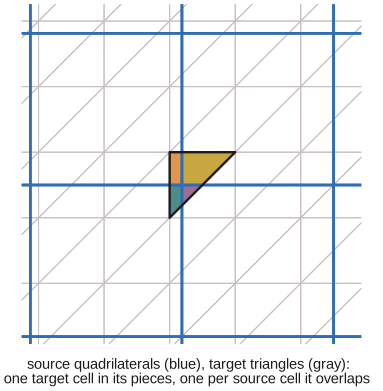
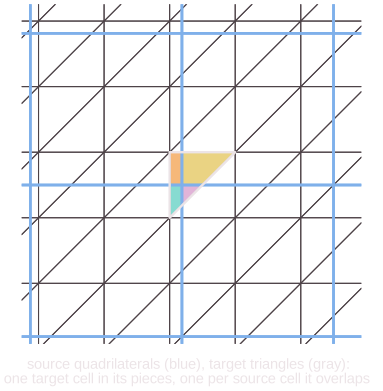
Each source cell's polynomial is integrated exactly over its intersection
with every target cell, so the integrals of all conserved variables are kept
to rounding and polynomial fields up to degree are remapped exactly. Every
variable of the file is remapped: the flow, species, temperature seeds and
[statistics] averages. The run continues from the file's step and time with
fresh output series; the log reports how closely the integrals were kept.
Pitfalls:
[initialize.mesh]must be the mesh the restart file was written on (its cell count is checked); a mesh file'stransformapplies to it as usual.- Where the meshes cover different domains (a curved wall discretized differently, a shorter box), target cells average over the covered part and cells outside take the nearest source cell; the log counts them, and conservation then holds only over the common part.
- The default
boundslimiter flattens smooth extrema slightly; uselimiter = "none"for smooth flows such as the Taylor-Green vortex. - Restarting on the same mesh is
type = "restart", which is bitwise exact.
Method, accuracy and cost: docs/design/remap.md.
See also
- Input reference:
[initialize] - Output and diagnostics: writing restart files and snapshots