Verification manual
Observed orders of accuracy of Mallard's discretizations, measured against exact and manufactured solutions: every reconstruction on every cell type, the Euler and Navier-Stokes operators, the time integrators, boundary conditions, curved boundaries, remapping and gas mixtures. The methods are described in the theory manual; stability limits and other measurements are in Numerical methods.
149 convergence studies from commit 6961ca7d (2026-10-23): all within their tests' bounds.
How the tables are made
Each study is a test of the test suite (mallard-test2d, mallard-test3d) that computes an error on two
resolutions \(n_1 < n_2\) (cells per side, or time steps) and checks the
observed order
against bounds of its own: usually a lower bound a little below the design
order (0.25 below in 2D, 0.5 on the coarser 3D meshes), which a
pre-asymptotic error may exceed. The tests check their orders
through one function, verification::expect_order
(test/verification.h), which also records
each study; tools/docs/verification.py
runs the tests and writes the tables, the plots and
results.json. A row passes when the test's bounds hold,
so a failing row is a failing test; a known deficiency links its issue.
Most studies run in every CI build. The rest of the matrix of reconstructions
and cell types, too slow for every run, is instantiated as
DISABLED_Verification/... and runs only here. All run on the CPU in double
precision, on the meshes of a few seconds' run.
Regenerating (on every release, and with any change to a scheme): build the test suite in 2D and 3D, then
(about 10 minutes on 4 cores; --jobs sets the number of test processes).
It exits with status 1 if a study fails, other than the known deficiencies
listed in the script. Without --test it redraws the
page and plots from results.json. The Verification workflow
(.github/workflows/verification.yml, dispatched by hand) does the same on
GitHub's runners and uploads the regenerated files.
Reconstruction on every cell type
Errors of the face values reconstructed from the exact cell averages of a smooth field: the operator alone, without time integration. In 2D, the maximum over interior face quadrature points; in 3D, over all faces, with the mirrored stencils of symmetry walls. Observed orders (TENO6 on mixed meshes is left out, at a minute per resolution; their cell types are covered one by one):
| Quadrilaterals | Triangles | Hexahedra | Tetrahedra | Prisms | Pyramids | Mixed | |
|---|---|---|---|---|---|---|---|
| TENO3 (design 3) | 2.89 | 2.92 | 2.72 | 2.68 | 2.81 | 2.88 | 2.54 |
| TENO4 (design 4) | 4.08 | 3.97 | 3.77 | 3.55 | 3.55 | 3.78 | 3.56 |
| TENO5 (design 5) | 4.90 | 4.98 | 4.93 | 4.73 | 5.07 | 4.84 | 5.04 |
| TENO6 (design 6) | 6.05 | 5.95 | 5.73 | 5.58 | 5.58 | 5.60 | – |
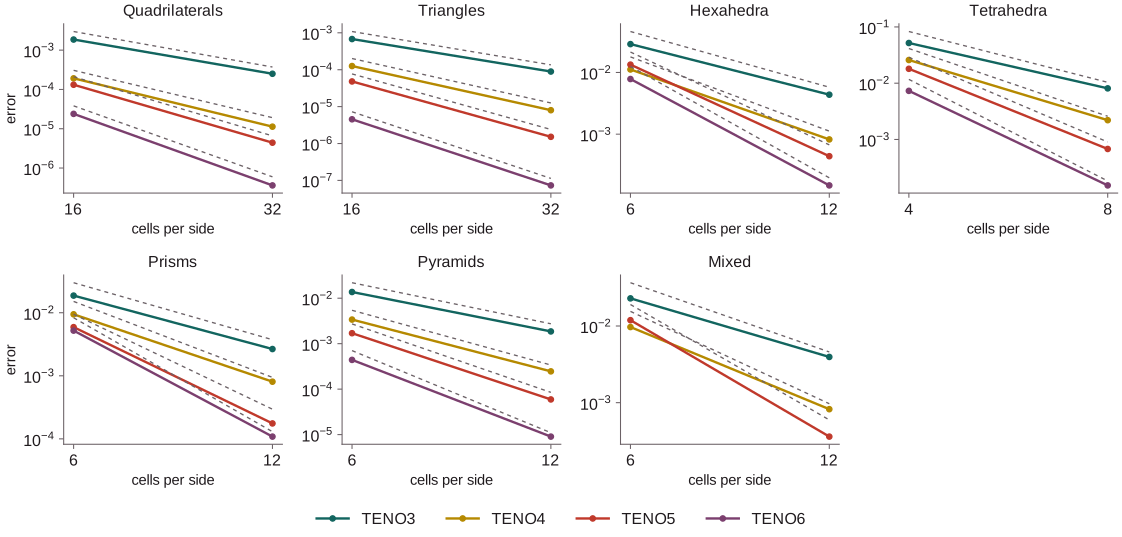
Dashed lines show the design slope of each study.
| Method | Cells | Error | Resolutions | Errors | Design | Observed | Asserted | Result |
|---|---|---|---|---|---|---|---|---|
| TENO3 | hexahedra | max face-value error | 6 → 12 | 2.89e-02 → 4.37e-03 | 3 | 2.72 | > 2.5 | pass |
| TENO4 | hexahedra | max face-value error | 6 → 12 | 1.12e-02 → 8.22e-04 | 4 | 3.77 | > 3.5 | pass |
| TENO5 | hexahedra | max face-value error | 6 → 12 | 1.34e-02 → 4.39e-04 | 5 | 4.93 | > 4.5 | pass |
| TENO5, troubled | hexahedra | max face-value error | 6 → 12 | 1.34e-02 → 4.39e-04 | 5 | 4.93 | > 4.5 | pass |
| TENO6 | hexahedra | max face-value error | 6 → 12 | 7.84e-03 → 1.48e-04 | 6 | 5.73 | > 5.5 | pass |
| TENO3 | tetrahedra | max face-value error | 4 → 8 | 5.18e-02 → 8.09e-03 | 3 | 2.68 | > 2.5 | pass |
| TENO4 | tetrahedra | max face-value error | 4 → 8 | 2.58e-02 → 2.20e-03 | 4 | 3.55 | > 3.5 | pass |
| TENO4, troubled | tetrahedra | max face-value error | 4 → 8 | 2.58e-02 → 2.20e-03 | 4 | 3.55 | > 3.5 | pass |
| TENO5 | tetrahedra | max face-value error | 4 → 8 | 1.80e-02 → 6.77e-04 | 5 | 4.73 | > 4.5 | pass |
| TENO6 | tetrahedra | max face-value error | 4 → 8 | 7.30e-03 → 1.52e-04 | 6 | 5.58 | > 5.5 | pass |
| TENO3 | prisms | max face-value error | 6 → 12 | 1.87e-02 → 2.66e-03 | 3 | 2.81 | > 2.5 | pass |
| TENO4 | prisms | max face-value error | 6 → 12 | 9.43e-03 → 8.07e-04 | 4 | 3.55 | > 3.5 | pass |
| TENO5 | prisms | max face-value error | 6 → 12 | 5.91e-03 → 1.76e-04 | 5 | 5.07 | > 4.5 | pass |
| TENO6 | prisms | max face-value error | 6 → 12 | 5.20e-03 → 1.09e-04 | 6 | 5.58 | > 5.5 | pass |
| TENO3 | pyramids | max face-value error | 6 → 12 | 1.37e-02 → 1.86e-03 | 3 | 2.88 | > 2.5 | pass |
| TENO4 | pyramids | max face-value error | 6 → 12 | 3.39e-03 → 2.46e-04 | 4 | 3.78 | > 3.5 | pass |
| TENO5 | pyramids | max face-value error | 6 → 12 | 1.70e-03 → 5.93e-05 | 5 | 4.84 | > 4.5 | pass |
| TENO6 | pyramids | max face-value error | 6 → 12 | 4.40e-04 → 9.03e-06 | 6 | 5.60 | > 5.5 | pass |
| TENO3 | mixed | max face-value error | 6 → 12 | 2.29e-02 → 3.95e-03 | 3 | 2.54 | > 2.5 | pass |
| TENO4 | mixed | max face-value error | 6 → 12 | 9.69e-03 → 8.22e-04 | 4 | 3.56 | > 3.5 | pass |
| TENO5 | mixed | max face-value error | 6 → 12 | 1.19e-02 → 3.61e-04 | 5 | 5.04 | > 4.5 | pass |
| TENO3 | quadrilaterals | max face-value error, interior | 16 → 32 | 1.86e-03 → 2.50e-04 | 3 | 2.89 | > 2.8 | pass |
| TENO4 | quadrilaterals | max face-value error, interior | 16 → 32 | 1.91e-04 → 1.13e-05 | 4 | 4.08 | > 3.8 | pass |
| TENO5 | quadrilaterals | max face-value error, interior | 16 → 32 | 1.32e-04 → 4.42e-06 | 5 | 4.90 | > 4.8 | pass |
| TENO6 | quadrilaterals | max face-value error, interior | 16 → 32 | 2.39e-05 → 3.61e-07 | 6 | 6.05 | > 5.8 | pass |
| TENO3 | triangles | max face-value error, interior | 16 → 32 | 6.77e-04 → 8.92e-05 | 3 | 2.92 | > 2.8 | pass |
| TENO4 | triangles | max face-value error, interior | 16 → 32 | 1.26e-04 → 7.99e-06 | 4 | 3.97 | > 3.8 | pass |
| TENO5 | triangles | max face-value error, interior | 16 → 32 | 4.81e-05 → 1.52e-06 | 5 | 4.98 | > 4.8 | pass |
| TENO6 | triangles | max face-value error, interior | 16 → 32 | 4.53e-06 → 7.33e-08 | 6 | 5.95 | > 5.8 | pass |
Euler equations: advection of a smooth wave
A density wave advected through a periodic box by a uniform flow at constant pressure, an exact solution of the Euler equations, for a quarter period with RK4 at \(\Delta t = h^{\max(1, p/4)}/4\), so that the time error stays below the spatial one (in 3D, a quarter of that on the thinner cells of the types other than hexahedra, for stability); the error is the largest difference from the exact cell averages. The full solver runs: reconstruction, HLLC fluxes, the face quadrature and the time integrator. Prisms and pyramids are periodic in two directions only; along the third the wave is uniform and bounded by symmetry walls. In 3D the coarse mesh has 16 cells per side at first order, 12 for MUSCL, TENO3 and TENO5, and 8 for TENO4 and TENO6; TENO5 and TENO6 run on hexahedra only, at several minutes per resolution on the other cells. Observed orders:
| Quadrilaterals | Triangles | Hexahedra | Tetrahedra | Prisms | Pyramids | Mixed | |
|---|---|---|---|---|---|---|---|
| FO (design 1) | 0.80 | 0.87 | 0.75 | 0.92 | 0.89 | 0.89 | 0.82 |
| MUSCL (design 2) | 2.20 | 2.07 | 2.28 | 2.31 | 2.02 | 1.90 | 2.08 |
| TENO3 (design 3) | 2.90 | 2.98 | 2.79 | 2.94 | 2.92 | 2.98 | 2.64 |
| TENO4 (design 4) | 4.41 | 4.05 | 4.26 | 4.07 | 4.20 | 4.18 | 3.75 |
| TENO5 (design 5) | 4.87 | 4.96 | 4.73 | – | – | – | – |
| TENO6 (design 6) | 6.40 | 5.97 | 6.07 | – | – | – | – |
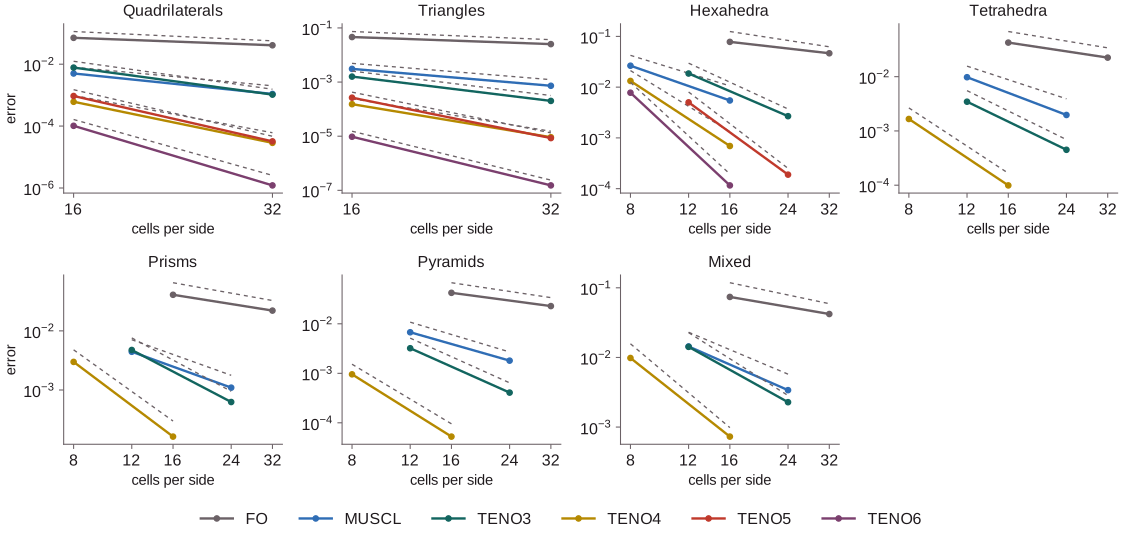
The pulse rows advect a Gaussian with SSPRK3 at fixed CFL, whose time error limits the observed order to 3.
| Method | Cells | Error | Resolutions | Errors | Design | Observed | Asserted | Result |
|---|---|---|---|---|---|---|---|---|
| TENO5, SSPRK3 | quadrilaterals | L1 density error, pulse | 32 → 64 | 2.97e-04 → 1.33e-05 | 3 | 4.48 | > 2.7 | pass |
| TENO5, SSPRK3 | triangles | L1 density error, pulse | 32 → 64 | 6.89e-05 → 3.46e-06 | 3 | 4.32 | > 2.7 | pass |
| TENO5, SSPRK3 | hexahedra | L1 density error, pulse | 12 → 24 | 1.48e-03 → 1.13e-04 | 3 | 3.71 | > 3 | pass |
| FO | quadrilaterals | max density error | 16 → 32 | 7.12e-02 → 4.09e-02 | 1 | 0.80 | > 0.75 | pass |
| MUSCL | quadrilaterals | max density error | 16 → 32 | 5.01e-03 → 1.09e-03 | 2 | 2.20 | > 1.75 | pass |
| TENO3 | quadrilaterals | max density error | 16 → 32 | 7.77e-03 → 1.04e-03 | 3 | 2.90 | > 2.75 | pass |
| TENO4 | quadrilaterals | max density error | 16 → 32 | 6.11e-04 → 2.87e-05 | 4 | 4.41 | > 3.75 | pass |
| TENO5 | quadrilaterals | max density error | 16 → 32 | 9.39e-04 → 3.21e-05 | 5 | 4.87 | > 4.75 | pass |
| TENO6 | quadrilaterals | max density error | 16 → 32 | 1.02e-04 → 1.21e-06 | 6 | 6.40 | > 5.75 | pass |
| FO | triangles | max density error | 16 → 32 | 4.60e-02 → 2.52e-02 | 1 | 0.87 | > 0.75 | pass |
| MUSCL | triangles | max density error | 16 → 32 | 3.07e-03 → 7.28e-04 | 2 | 2.07 | > 1.75 | pass |
| TENO3 | triangles | max density error | 16 → 32 | 1.59e-03 → 2.01e-04 | 3 | 2.98 | > 2.75 | pass |
| TENO4 | triangles | max density error | 16 → 32 | 1.52e-04 → 9.16e-06 | 4 | 4.05 | > 3.75 | pass |
| TENO5 | triangles | max density error | 16 → 32 | 2.65e-04 → 8.51e-06 | 5 | 4.96 | > 4.75 | pass |
| TENO6 | triangles | max density error | 16 → 32 | 9.54e-06 → 1.52e-07 | 6 | 5.97 | > 5.75 | pass |
| FO | hexahedra | max density error | 16 → 32 | 7.81e-02 → 4.65e-02 | 1 | 0.75 | > 0.5 | pass |
| MUSCL | hexahedra | max density error | 8 → 16 | 2.65e-02 → 5.46e-03 | 2 | 2.28 | > 1.75 | pass |
| TENO3 | hexahedra | max density error | 12 → 24 | 1.86e-02 → 2.68e-03 | 3 | 2.79 | > 2.5 | pass |
| TENO4 | hexahedra | max density error | 8 → 16 | 1.33e-02 → 6.92e-04 | 4 | 4.26 | > 3.75 | pass |
| TENO5 | hexahedra | max density error | 12 → 24 | 5.02e-03 → 1.89e-04 | 5 | 4.73 | > 4.5 | pass |
| TENO6 | hexahedra | max density error | 8 → 16 | 7.78e-03 → 1.16e-04 | 6 | 6.07 | > 5.5 | pass |
| FO | tetrahedra | max density error | 16 → 32 | 4.25e-02 → 2.25e-02 | 1 | 0.92 | > 0.5 | pass |
| MUSCL | tetrahedra | max density error | 12 → 24 | 9.78e-03 → 1.97e-03 | 2 | 2.31 | > 1.5 | pass |
| TENO3 | tetrahedra | max density error | 12 → 24 | 3.46e-03 → 4.49e-04 | 3 | 2.94 | > 2.5 | pass |
| TENO4 | tetrahedra | max density error | 8 → 16 | 1.66e-03 → 9.91e-05 | 4 | 4.07 | > 3.5 | pass |
| FO | prisms | max density error | 16 → 32 | 4.07e-02 → 2.20e-02 | 1 | 0.89 | > 0.5 | pass |
| MUSCL | prisms | max density error | 12 → 24 | 4.43e-03 → 1.10e-03 | 2 | 2.02 | > 1.5 | pass |
| TENO3 | prisms | max density error | 12 → 24 | 4.75e-03 → 6.26e-04 | 3 | 2.92 | > 2.5 | pass |
| TENO4 | prisms | max density error | 8 → 16 | 2.98e-03 → 1.63e-04 | 4 | 4.20 | > 3.5 | pass |
| FO | pyramids | max density error | 16 → 32 | 4.23e-02 → 2.28e-02 | 1 | 0.89 | > 0.5 | pass |
| MUSCL | pyramids | max density error | 12 → 24 | 6.75e-03 → 1.80e-03 | 2 | 1.90 | > 1.5 | pass |
| TENO3 | pyramids | max density error | 12 → 24 | 3.21e-03 → 4.07e-04 | 3 | 2.98 | > 2.5 | pass |
| TENO4 | pyramids | max density error | 8 → 16 | 9.54e-04 → 5.26e-05 | 4 | 4.18 | > 3.5 | pass |
| FO | mixed | max density error | 16 → 32 | 7.39e-02 → 4.20e-02 | 1 | 0.82 | > 0.5 | pass |
| MUSCL | mixed | max density error | 12 → 24 | 1.44e-02 → 3.39e-03 | 2 | 2.08 | > 1.5 | pass |
| TENO3 | mixed | max density error | 12 → 24 | 1.42e-02 → 2.28e-03 | 3 | 2.64 | > 2.5 | pass |
| TENO4 | mixed | max density error | 8 → 16 | 9.82e-03 → 7.30e-04 | 4 | 3.75 | > 3.5 | pass |
Navier-Stokes equations: viscous operators
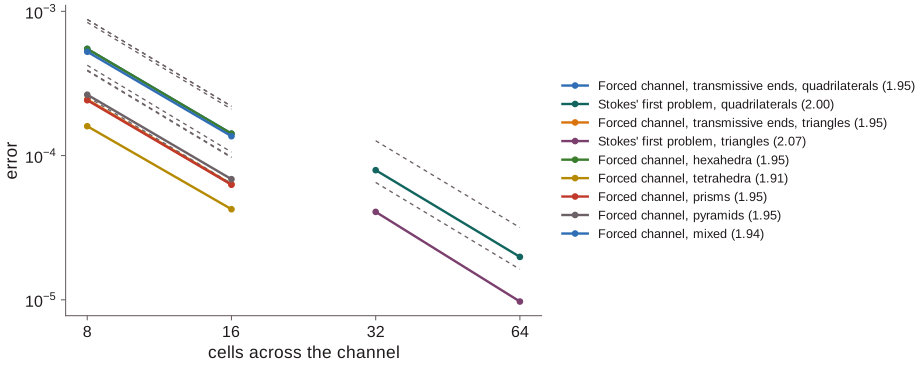
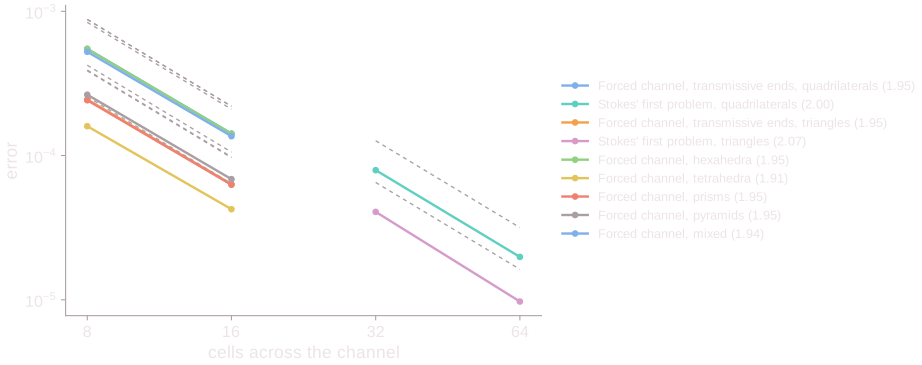
Stokes' first problem (an impulsively started isothermal wall, with the erfc profile as exact solution) and a channel driven by a body force between isothermal walls at rest, \(u = 0.05\,(y - y^3)\): in 2D a strip with transmissive ends, in 3D a column of 3 x 3 cells with periodic sides (walls normal to \(y\) on prisms, which are not periodic in \(y\), else to \(z\)). All use MUSCL with the Venkatakrishnan limiter and the second-order viscous gradients.
| Method | Cells | Error | Resolutions | Errors | Design | Observed | Asserted | Result |
|---|---|---|---|---|---|---|---|---|
| Forced channel, transmissive ends | quadrilaterals | max velocity error | 8 → 16 | 5.49e-04 → 1.42e-04 | 2 | 1.95 | > 1.8 | pass |
| Stokes' first problem | quadrilaterals | max velocity error | 32 → 64 | 7.92e-05 → 1.98e-05 | 2 | 2.00 | > 1.8 | pass |
| Forced channel, transmissive ends | triangles | max velocity error | 8 → 16 | 2.45e-04 → 6.33e-05 | 2 | 1.95 | > 1.8 | pass |
| Stokes' first problem | triangles | max velocity error | 32 → 64 | 4.07e-05 → 9.72e-06 | 2 | 2.07 | > 1.8 | pass |
| Forced channel | hexahedra | max velocity error | 8 → 16 | 5.49e-04 → 1.42e-04 | 2 | 1.95 | > 1.8 | pass |
| Forced channel | tetrahedra | max velocity error | 8 → 16 | 1.60e-04 → 4.25e-05 | 2 | 1.91 | > 1.8 | pass |
| Forced channel | prisms | max velocity error | 8 → 16 | 2.42e-04 → 6.27e-05 | 2 | 1.95 | > 1.8 | pass |
| Forced channel | pyramids | max velocity error | 8 → 16 | 2.64e-04 → 6.86e-05 | 2 | 1.95 | > 1.8 | pass |
| Forced channel | mixed | max velocity error | 8 → 16 | 5.24e-04 → 1.36e-04 | 2 | 1.94 | > 1.8 | pass |
Time integrators
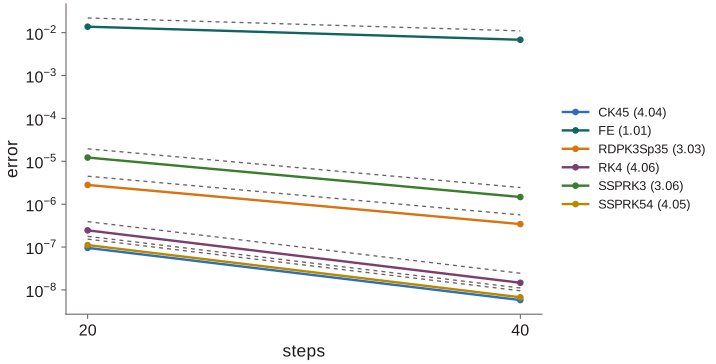
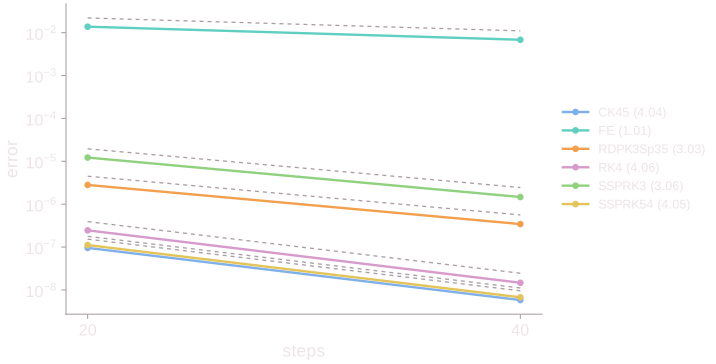
The linear system \(\mathrm{d}U_i/\mathrm{d}t = \lambda_i U_i\) to \(t = 1\) checks each method's order; \(\mathrm{d}U/\mathrm{d}t = \cos t\) checks that the stages are evaluated at the right times. RODAS, the stiff integrator of the chemistry, runs the Van der Pol oscillator.
| Method | Cells | Error | Resolutions | Errors | Design | Observed | Asserted | Result |
|---|---|---|---|---|---|---|---|---|
| RODAS (chemistry) | – | error, Van der Pol oscillator | 32 → 64 | 3.86e-09 → 2.39e-10 | 4 | 4.01 | 3.8 to 4.3 | pass |
| CK45 | – | error, time-dependent right-hand side | 10 → 20 | 3.69e-10 → 2.17e-11 | 4 | 4.09 | > 3.85 | pass |
| RDPK3Sp35 | – | error, time-dependent right-hand side | 10 → 20 | 5.23e-09 → 3.25e-10 | 3 | 4.01 | > 2.85 | pass |
| RK4 | – | error, time-dependent right-hand side | 10 → 20 | 2.92e-08 → 1.83e-09 | 4 | 4.00 | > 3.85 | pass |
| SSPRK3 | – | error, time-dependent right-hand side | 10 → 20 | 2.92e-08 → 1.83e-09 | 3 | 4.00 | > 2.85 | pass |
| SSPRK54 | – | error, time-dependent right-hand side | 10 → 20 | 1.69e-08 → 1.06e-09 | 4 | 4.00 | > 3.85 | pass |
| RDPK3Sp35 error estimate | – | estimate after one step | 10 → 20 | 2.67e-06 → 3.41e-07 | 3 | 2.97 | 2.9 to 3.1 | pass |
| RODAS error estimate | – | local error estimate, Van der Pol oscillator | 32 → 64 | 5.98e-07 → 4.07e-08 | 4 | 3.88 | 3.8 to 4.3 | pass |
| CK45 | – | max error, linear system | 20 → 40 | 9.56e-08 → 5.81e-09 | 4 | 4.04 | 3.9 to 4.1 | pass |
| FE | – | max error, linear system | 20 → 40 | 1.38e-02 → 6.82e-03 | 1 | 1.01 | 0.9 to 1.1 | pass |
| RDPK3Sp35 | – | max error, linear system | 20 → 40 | 2.81e-06 → 3.43e-07 | 3 | 3.03 | 2.9 to 3.1 | pass |
| RK4 | – | max error, linear system | 20 → 40 | 2.45e-07 → 1.47e-08 | 4 | 4.06 | 3.9 to 4.1 | pass |
| SSPRK3 | – | max error, linear system | 20 → 40 | 1.22e-05 → 1.47e-06 | 3 | 3.06 | 2.9 to 3.1 | pass |
| SSPRK54 | – | max error, linear system | 20 → 40 | 1.11e-07 → 6.73e-09 | 4 | 4.05 | 3.9 to 4.1 | pass |
Boundary conditions
The TENO face values next to symmetry walls, where the stencils include the mirror images of the cells, and the 3D forced channel of the previous section with transmissive sides (2 x 2 cells) in place of periodic ones, where the fluxes and gradient stencils continue across the sides through the image cells as they would across a periodic seam. The viscous studies also verify isothermal no-slip and moving walls; the axisymmetric studies below, the axis.
| Method | Cells | Error | Resolutions | Errors | Design | Observed | Asserted | Result |
|---|---|---|---|---|---|---|---|---|
| TENO3 | quadrilaterals | max face-value error, symmetry walls | 32 → 64 | 3.65e-04 → 4.60e-05 | 3 | 2.99 | > 2.6 | pass |
| TENO4 | quadrilaterals | max face-value error, symmetry walls | 32 → 64 | 2.69e-05 → 1.73e-06 | 4 | 3.96 | > 3.6 | pass |
| TENO5 | quadrilaterals | max face-value error, symmetry walls | 32 → 64 | 6.57e-06 → 2.08e-07 | 5 | 4.98 | > 4.6 | pass |
| TENO6 | quadrilaterals | max face-value error, symmetry walls | 32 → 64 | 7.36e-07 → 1.19e-08 | 6 | 5.96 | > 5.6 | pass |
| TENO3 | triangles | max face-value error, symmetry walls | 32 → 64 | 1.28e-04 → 1.62e-05 | 3 | 2.98 | > 2.6 | pass |
| TENO4 | triangles | max face-value error, symmetry walls | 32 → 64 | 1.22e-05 → 7.74e-07 | 4 | 3.97 | > 3.6 | pass |
| TENO5 | triangles | max face-value error, symmetry walls | 32 → 64 | 2.09e-06 → 6.69e-08 | 5 | 4.96 | > 4.6 | pass |
| TENO6 | triangles | max face-value error, symmetry walls | 32 → 64 | 1.26e-07 → 2.02e-09 | 6 | 5.97 | > 5.6 | pass |
| Forced channel, transmissive sides | hexahedra | max velocity error | 8 → 16 | 5.49e-04 → 1.42e-04 | 2 | 1.95 | > 1.8 | pass |
| Forced channel, transmissive sides | tetrahedra | max velocity error | 8 → 16 | 1.94e-04 → 4.78e-05 | 2 | 2.02 | > 1.8 | pass |
| Forced channel, transmissive sides | prisms | max velocity error | 8 → 16 | 2.45e-04 → 6.32e-05 | 2 | 1.95 | > 1.8 | pass |
| Forced channel, transmissive sides | pyramids | max velocity error | 8 → 16 | 2.64e-04 → 6.86e-05 | 2 | 1.95 | > 1.8 | pass |
| Forced channel, transmissive sides | mixed | max velocity error | 8 → 16 | 4.28e-04 → 1.18e-04 | 2 | 1.86 | > 1.8 | pass |
Axisymmetric flows
The spatial operator at the exact \(r\)-weighted averages of a manufactured state, up to and including the cells on the axis (a residual, one order below the reconstruction's), and the viscous residual of Poiseuille pipe flow.
| Method | Cells | Error | Resolutions | Errors | Design | Observed | Asserted | Result |
|---|---|---|---|---|---|---|---|---|
| Poiseuille pipe flow | quadrilaterals | mean axial momentum residual | 8 → 16 | 6.10e-07 → 1.28e-07 | 2 | 2.26 | > 1.8 | pass |
| TENO3 | quadrilaterals | mean residual error, manufactured solution | 16 → 32 | 2.92e-02 → 3.42e-03 | 2 | 3.09 | > 1.7 | pass |
| TENO4 | quadrilaterals | mean residual error, manufactured solution | 16 → 32 | 5.40e-03 → 2.45e-04 | 3 | 4.46 | > 2.7 | pass |
| TENO5 | quadrilaterals | mean residual error, manufactured solution | 16 → 32 | 5.06e-03 → 1.22e-04 | 4 | 5.37 | > 3.7 | pass |
| TENO3 | triangles | mean residual error, manufactured solution | 16 → 32 | 2.33e-02 → 4.83e-03 | 2 | 2.27 | > 1.7 | pass |
| TENO4 | triangles | mean residual error, manufactured solution | 16 → 32 | 7.91e-03 → 7.38e-04 | 3 | 3.42 | > 2.7 | pass |
| TENO5 | triangles | mean residual error, manufactured solution | 16 → 32 | 8.73e-03 → 5.94e-05 | 4 | 7.20 | > 3.7 | pass |
Curved boundaries
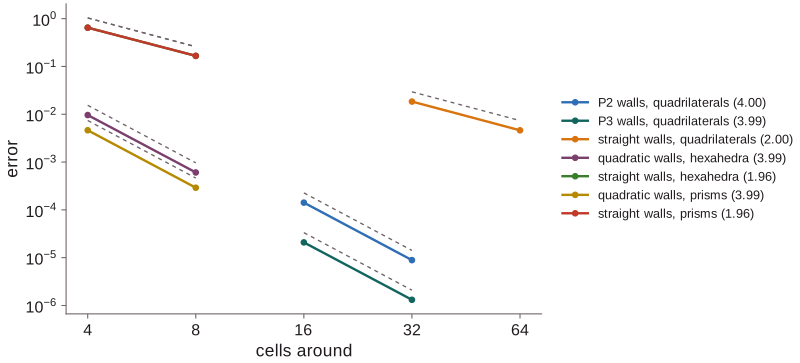
The area of an annulus and the volume of a spherical shell meshed with straight and with curved walls, and the TENO wall values from the exact averages over the curved cells. Seen as straight-sided cells, the same averages give second order at best; by default orders 5 and 6 fit degree 3 in the cells whose stencils reach a curved wall.
| Method | Cells | Error | Resolutions | Errors | Design | Observed | Asserted | Result |
|---|---|---|---|---|---|---|---|---|
| P2 walls | quadrilaterals | annulus area error | 16 → 32 | 1.42e-04 → 8.90e-06 | 4 | 4.00 | > 3.8 | pass |
| P3 walls | quadrilaterals | annulus area error | 16 → 32 | 2.09e-05 → 1.32e-06 | 4 | 3.99 | > 3.8 | pass |
| straight walls | quadrilaterals | annulus area error | 32 → 64 | 1.84e-02 → 4.62e-03 | 2 | 2.00 | 1.95 to 2.05 | pass |
| TENO3, curved walls | quadrilaterals | max wall-value error | 4 → 8 | 3.27e-03 → 4.34e-04 | 3 | 2.91 | > 2.5 | pass |
| TENO3, straight-sided cells | quadrilaterals | max wall-value error | 4 → 8 | 2.21e-02 → 1.08e-02 | 2 | 1.03 | < 2.3 | pass |
| TENO4, curved walls | quadrilaterals | max wall-value error | 4 → 8 | 1.37e-03 → 7.22e-05 | 4 | 4.24 | > 3.5 | pass |
| TENO4, straight-sided cells | quadrilaterals | max wall-value error | 4 → 8 | 1.53e-02 → 7.50e-03 | 2 | 1.03 | < 2.3 | pass |
| TENO5, curved walls | quadrilaterals | max wall-value error | 4 → 8 | 7.00e-04 → 9.72e-06 | 5 | 6.17 | > 4.5 | pass |
| TENO5, curved walls, wall degree 3 | quadrilaterals | max wall-value error | 4 → 8 | 1.42e-03 → 7.52e-05 | 4 | 4.23 | 3.5 to 4.5 | pass |
| TENO5, curved walls, wall degree 4 | quadrilaterals | max wall-value error | 4 → 8 | 7.00e-04 → 9.72e-06 | 5 | 6.17 | > 4.5 | pass |
| TENO5, straight-sided cells | quadrilaterals | max wall-value error | 4 → 8 | 2.16e-02 → 1.06e-02 | 2 | 1.03 | < 2.3 | pass |
| TENO6, curved walls | quadrilaterals | max wall-value error | 4 → 8 | 2.13e-03 → 1.43e-05 | 6 | 7.22 | > 5.5 | pass |
| TENO6, straight-sided cells | quadrilaterals | max wall-value error | 4 → 8 | 1.80e-02 → 8.96e-03 | 2 | 1.01 | < 2.3 | pass |
| TENO3, curved walls | triangles | max wall-value error | 4 → 8 | 2.47e-03 → 3.30e-04 | 3 | 2.91 | > 2.5 | pass |
| TENO3, straight-sided cells | triangles | max wall-value error | 4 → 8 | 1.76e-02 → 8.85e-03 | 2 | 0.99 | < 2.3 | pass |
| TENO4, curved walls | triangles | max wall-value error | 4 → 8 | 5.68e-04 → 4.27e-05 | 4 | 3.73 | > 3.5 | pass |
| TENO4, straight-sided cells | triangles | max wall-value error | 4 → 8 | 2.32e-02 → 1.17e-02 | 2 | 0.98 | < 2.3 | pass |
| TENO5, curved walls | triangles | max wall-value error | 4 → 8 | 1.91e-04 → 7.51e-06 | 5 | 4.67 | > 4.5 | pass |
| TENO5, straight-sided cells | triangles | max wall-value error | 4 → 8 | 2.22e-02 → 1.10e-02 | 2 | 1.01 | < 2.3 | pass |
| TENO6, curved walls | triangles | max wall-value error | 4 → 8 | 2.81e-04 → 1.40e-06 | 6 | 7.65 | > 5.5 | pass |
| TENO6, straight-sided cells | triangles | max wall-value error | 4 → 8 | 1.97e-02 → 9.25e-03 | 2 | 1.09 | < 2.3 | pass |
| quadratic walls | hexahedra | spherical shell volume error | 4 → 8 | 9.63e-03 → 6.07e-04 | 4 | 3.99 | > 3.7 | pass |
| straight walls | hexahedra | spherical shell volume error | 4 → 8 | 6.48e-01 → 1.66e-01 | 2 | 1.96 | 1.85 to 2.15 | pass |
| quadratic walls | prisms | spherical shell volume error | 4 → 8 | 4.63e-03 → 2.91e-04 | 4 | 3.99 | > 3.7 | pass |
| straight walls | prisms | spherical shell volume error | 4 → 8 | 6.48e-01 → 1.66e-01 | 2 | 1.96 | 1.85 to 2.15 | pass |
Remapping
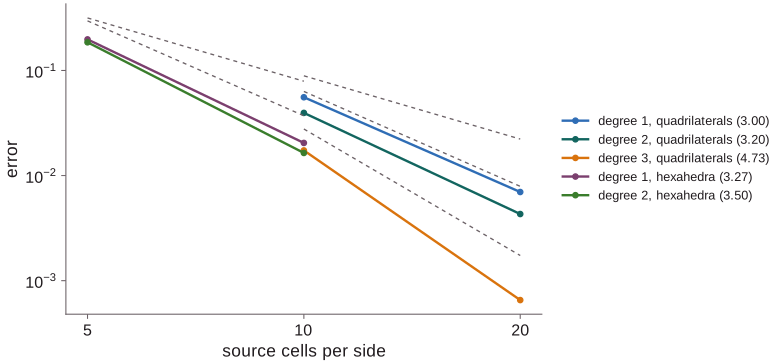
Conservative remapping of a smooth periodic field between unrelated meshes, by the overlap integrals of piecewise polynomials of each degree, unlimited: the target cell averages converge at the degree plus one.
| Method | Cells | Error | Resolutions | Errors | Design | Observed | Asserted | Result |
|---|---|---|---|---|---|---|---|---|
| degree 1 | quadrilaterals | max error of the target averages | 10 → 20 | 5.56e-02 → 6.97e-03 | 2 | 3.00 | > 1.6 | pass |
| degree 2 | quadrilaterals | max error of the target averages | 10 → 20 | 3.95e-02 → 4.30e-03 | 3 | 3.20 | > 2.6 | pass |
| degree 3 | quadrilaterals | max error of the target averages | 10 → 20 | 1.73e-02 → 6.53e-04 | 4 | 4.73 | > 3.6 | pass |
| degree 1 | hexahedra | max error of the target averages | 5 → 10 | 1.98e-01 → 2.04e-02 | 2 | 3.27 | > 1.6 | pass |
| degree 2 | hexahedra | max error of the target averages | 5 → 10 | 1.85e-01 → 1.64e-02 | 3 | 3.50 | > 2.6 | pass |
Gas mixtures
A smooth wave of H2 in N2 and of temperature advected at uniform velocity and pressure, thermally perfect: both the flow variables and the species reach the scheme's order.
| Method | Cells | Error | Resolutions | Errors | Design | Observed | Asserted | Result |
|---|---|---|---|---|---|---|---|---|
| MUSCL | quadrilaterals | L1 H2 partial density error | 16 → 32 | 8.15e-06 → 1.86e-06 | 2 | 2.13 | > 1.8 | pass |
| TENO3 | quadrilaterals | L1 H2 partial density error | 32 → 64 | 1.91e-06 → 2.80e-07 | 3 | 2.77 | > 2.6 | pass |
| TENO5 | triangles | L1 H2 partial density error | 16 → 32 | 5.37e-05 → 4.27e-07 | 5 | 6.98 | > 4 | pass |
| MUSCL | hexahedra | L1 H2 partial density error | 8 → 16 | 3.54e-05 → 8.15e-06 | 2 | 2.12 | > 1.8 | pass |
| TENO3 | hexahedra | L1 H2 partial density error | 8 → 16 | 1.27e-04 → 1.14e-05 | 3 | 3.47 | > 2.4 | pass |
| MUSCL | quadrilaterals | L1 density error | 16 → 32 | 2.63e-04 → 6.44e-05 | 2 | 2.03 | > 1.8 | pass |
| TENO3 | quadrilaterals | L1 density error | 32 → 64 | 5.51e-05 → 7.02e-06 | 3 | 2.97 | > 2.6 | pass |
| TENO5 | triangles | L1 density error | 16 → 32 | 7.28e-05 → 2.55e-06 | 5 | 4.83 | > 4 | pass |
| MUSCL | hexahedra | L1 density error | 8 → 16 | 1.17e-03 → 2.63e-04 | 2 | 2.15 | > 1.8 | pass |
| TENO3 | hexahedra | L1 density error | 8 → 16 | 1.50e-03 → 2.49e-04 | 3 | 2.60 | > 2.4 | pass |
Not covered
- The reacting source terms in space (chemistry is verified as an ODE integrator, above, and against Cantera in the validation cases).
- Mixture-averaged transport, LES models and characteristic boundaries, which are tested for exactness and consistency, not for an order.
- Discontinuous solutions, whose errors converge at order 1 or below regardless of the scheme; see the validation cases.